
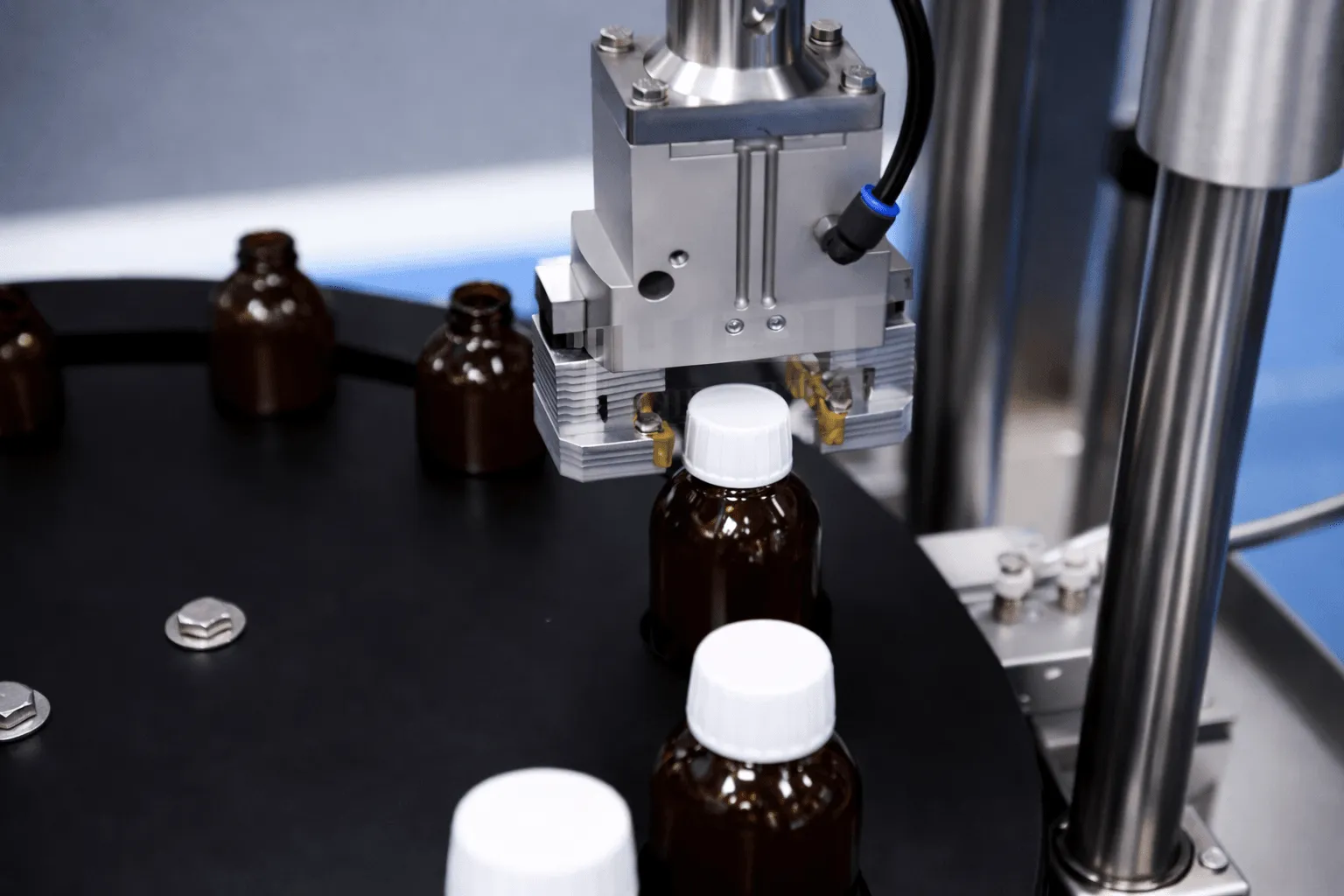
On a medicine bottle, the cap is the last barrier between the product and the outside. An under-tightened cap leaks; an over-tightened one is hard to open and can break the tamper-evident ring. The Türesan medicine bottle capping machine is designed to apply the same torque to every bottle.
Capping method by cap type
- Screw and tamper-evident caps: servo torque gripper or three-ball capping.
- Spray, pump and dropper caps: pick & place cap placement followed by torque-controlled tightening.
- Snap-on (press) caps: press capping unit.
- Aluminium caps: rolling (crimp) capping.
For capping, gripper, three-ball, pick & place, flat clamping, rolling and press systems are available, driven by servo torque, asynchronous motor, mechanical torque or air motor. Caps are fed to the station by an elevator, vibratory bowl or rotary table.
Linear or rotary?
The linear capping machine gives flexibility where formats change often and several bottle sizes run on the same line. The rotary capping machine suits high-capacity, continuous production. Both have an AISI 304 stainless steel frame; on the rotary system the product-contact surfaces are AISI 316L.
Position on the line
The capping station usually follows the syrup filling machine and is followed by medicine bottle labelling. Line-full sensors at the infeed and outfeed stop uncapped bottles from moving on.
Related pages: Capping machines · Linear system capping machine · Rotary system capping machine · Contact us for a quote
Frequently Asked Questions
Which cap types can it close?
Screw, tamper-evident, pump, spray and snap-on caps; depending on the cap, gripper, three-ball, pick & place, press or rolling capping is used.
How is the torque set?
With servo torque drive, the torque value is stored as a product recipe and every bottle is closed at the same value.
How are the caps fed?
Caps are fed to the capping station by an elevator, vibratory bowl or rotary table.